From Manual Workflows to a Business That Moves at Startup Speed

Client Profile

Industry: Specialty E-Commerce / Consumer Products
Company Size: 22 employees
Stage: Early-stage startup
Environment: Microsoft 365 | Cloud-based operations | Small cross-functional team

The startup had a strong product and a growing customer base.

But behind the scenes, many everyday business processes were still being managed through email, spreadsheets, shared folders, and manual follow-ups.

As the company grew, the founders realized something important:

They were spending too much time running the business—and not enough time growing it.

What They Wanted to Achieve

The leadership team wanted to:

  • Automate repetitive administrative processes
  • Reduce email-driven approvals
  • Eliminate duplicate data entry
  • Create visibility into operational requests
  • Speed up internal approvals
  • Standardize business processes
  • Reduce dependency on individual employees
  • Create scalable workflows without adding unnecessary headcount
  • Allow employees to focus on customers, products, and growth
Their objective

Build simple digital workflows that allow a 22-person company to operate with the efficiency of a much larger organization.

The Challenges

Everything Started With an Email

Requests for purchasing, expenses, approvals, onboarding, and operational tasks were often initiated through email.

Important information could become buried in inboxes.

Spreadsheets Were Running the Business

Several operational processes relied on manually maintained spreadsheets.

That created:

  • Duplicate data
  • Version-control problems
  • Manual updates
  • Reporting delays
  • Human errors

Approvals Were Slow

Employees frequently had to send reminders to get approvals completed.

A simple request could sit for hours—or days.

No Central Process Visibility

Management couldn’t easily answer:

What’s pending?
Who’s responsible?
How long has it been waiting?
What’s overdue?

Employees Were Doing Work the System Could Do

People were spending valuable time:

Copying data → Sending emails → Updating spreadsheets → Following up → Creating reports

The startup was effectively using people as workflow engines.

How OJASVI Advised the Client

We Didn’t Automate Everything. We Automated What Mattered.

OJASVI began by mapping the company’s highest-volume and most time-consuming processes.

We evaluated:

Frequency
Manual effort
Number of people involved
Approval requirements
Error potential
Business impact
Automation opportunity

We then prioritized workflows based on:

High volume + high manual effort + clear business rules

This prevented the startup from building complicated automation simply because the technology made it possible.

The Recommended Solution

Microsoft Power Platform

OJASVI designed a lightweight automation environment using:

Power Automate

To automate approvals, notifications, data movement, reminders, and business workflows.

Power Apps

To provide simple business applications and forms where email and spreadsheets were creating unnecessary friction.

Dataverse / SharePoint

To provide structured data storage appropriate to each workflow.

Microsoft Teams

To bring workflow notifications and approvals into the team’s existing collaboration environment.

Power BI

To provide visibility into workflow activity, turnaround times, bottlenecks, and operational trends where appropriate.

The First Workflows We Automated
  1. Purchase Request & Approval

Before

Employee → Email → Manager → Follow-up → Spreadsheet → Finance

After

Power App → Automated approval → Decision → Notification → Record

The process became structured, traceable, and easier to manage.

  1. Employee Onboarding

The startup had been manually coordinating:

HR → IT → Manager → Finance → Employee

OJASVI created an automated workflow that triggered tasks for each responsible team when a new employee was added.

This ensured that:

  • Accounts were requested
  • Equipment requirements were captured
  • Access tasks were assigned
  • Managers received notifications
  • HR could track completion
  1. Customer/Partner Requests

Requests that previously arrived through email were captured through a standardized form.

Power Automate then:

Captured → Categorized → Assigned → Notified → Tracked → Closed

  1. Expense Approval

Employees submitted expenses through a structured workflow.

The system automatically routed the request to the appropriate approver and notified Finance after approval.

  1. Automated Reminders

Instead of employees manually chasing pending actions, automated reminders were triggered when workflows exceeded defined time thresholds.

What OJASVI Was Able to Solve

Email Dependency

→ Converted email-driven processes into structured workflows.

Spreadsheet Dependency

→ Replaced manual tracking with centralized digital processes.

Approval Delays

→ Automated routing, notifications, and reminders.

Duplicate Data Entry

→ Allowed information to flow automatically between steps.

Limited Visibility

→ Created dashboards and workflow status views.

Employee Dependency

→ Standardized processes so they weren’t dependent on one person’s memory.

Scaling Challenges

→ Created repeatable workflows that could handle increased volume without proportional increases in administrative effort.

The Biggest Change

The Business Started Moving at the Speed of the Decision—Not the Speed of the Inbox.

Before:

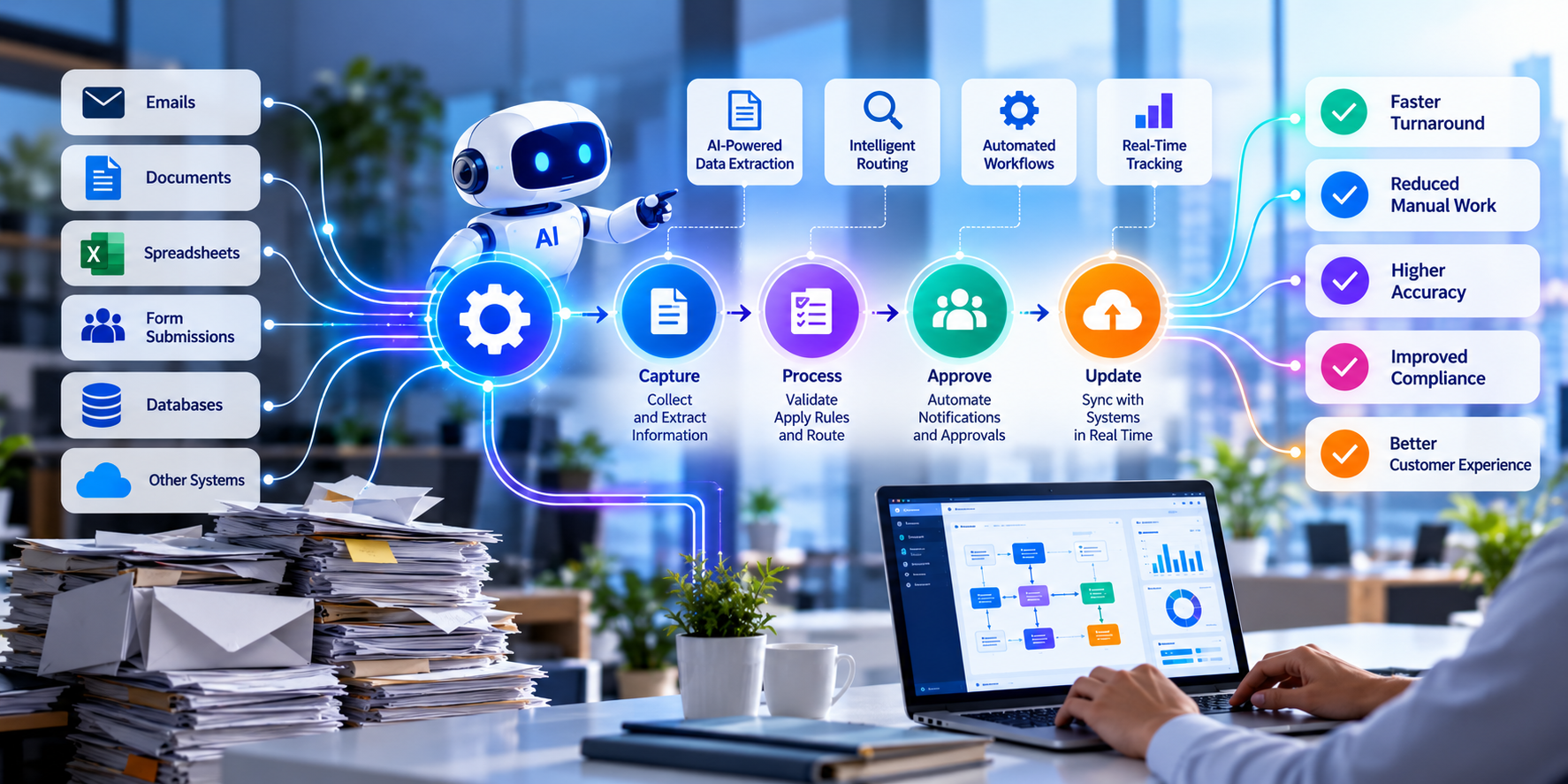
Request → Email → Wait → Follow-up → Approve → Update → Report

After:

Request → Automate → Approve → Execute → Track

The technology quietly handled the repetitive steps.

People focused on the decisions.

Time Saved

For a 22-person startup, even small amounts of administrative work can consume a surprising amount of capacity.

The initial automation program targeted approximately 8–10 recurring workflows.

Illustrative impact

Process

Monthly Time Before

Monthly Time After

Potential Time Recovered

Purchase approvals

18 hrs

6 hrs

12 hrs

Employee onboarding

12 hrs

4 hrs

8 hrs

Customer/partner requests

20 hrs

8 hrs

12 hrs

Expense processing

10 hrs

3 hrs

7 hrs

Follow-ups & reminders

18 hrs

4 hrs

14 hrs

Reporting & reconciliation

15 hrs

5 hrs

10 hrs

Total

93 hrs

30 hrs

~63 hrs/month

Potential capacity recovered: ~750 hours per year

Illustrative scenario. Actual savings depend on workflow volume, process complexity, number of users, and automation scope.

What Did Those Hours Become?

This is where the real value emerged.

The startup didn’t simply save administrative hours.

It redirected that capacity toward:

Customer acquisition
Product development
Customer experience
Partner relationships
Market expansion
Strategic planning

The goal wasn’t to make employees work faster.

It was to stop making them do work that software could do for them.

How It Supported Growth

The startup could now increase transaction and request volume without increasing administrative work at the same rate.

A new employee didn’t require someone to manually coordinate every onboarding step.

A new approval didn’t require another email chain.

A higher volume of customer requests didn’t require another spreadsheet.

The workflows became a scalable operating layer for the business.

Business Value

Simplify

Replace fragmented email and spreadsheet processes with structured digital workflows.

Accelerate

Move approvals, requests, and operational processes faster.

Standardize

Create consistent processes across the organization.

Increase Visibility

Know what’s pending, who’s responsible, and where bottlenecks exist.

Free People

Reduce repetitive administrative work.

Scale

Handle increasing business volume without proportionally increasing administrative overhead.

The OJASVI Difference

We Don’t Automate for the Sake of Automation.

We identify where automation can remove friction, repetition, delay, and unnecessary human effort.

Our approach:

Discover → Prioritize → Design → Automate → Measure → Improve

The result is not simply a collection of Power Automate flows.

It’s a smarter way for the business to operate.

Scroll to Top

"*" indicates required fields

"*" indicates required fields

Step 1 of 19

Analytics Journey Assessment Questionnaire
Digital transformation often requires skills across multiple roles and departments. This Analytics assessment questionnaire will walk you through a series of questions to evaluate your company’s readiness for implementing analytics in the departments that matter most in the company.
Please take a moment to complete the questionnaire

"*" indicates required fields

Step 1 of 22

Cloud Adoption Assessment Questionnaire
Digital transformation often requires skills across multiple roles and departments. This Cloud adoption assessment questionnaire will walk you through a series of questions to evaluate your company’s readiness for cloud adoption in various areas.
Please take a moment to complete the questionnaire

"*" indicates required fields

Step 1 of 7

Cloud Governance Assessment Questionnaire
Digital transformation often requires skills across multiple roles and departments. This Migration assessment questionnaire will walk you through a series of questions to evaluate your company’s readiness for cloud migration in various areas.
Please take a moment to complete the questionnaire

"*" indicates required fields

Step 1 of 52

Devops Capability Assessment
Digital transformation often requires skills across multiple roles and departments. This DevOps assessment questionnaire will walk you through a series of questions to evaluate your company’s readiness to adopt continuous processes throughout.
Please take a moment to complete the questionnaire

"*" indicates required fields

Step 1 of 40

Planning Cloud Journey Assessment Questionnaire
Digital transformation often requires skills across multiple roles and departments. This Cloud planning assessment questionnaire will walk you through a series of questions to evaluate your company’s readiness for moving to cloud & strategy.
Please take a moment to complete the questionnaire

"*" indicates required fields

Step 1 of 12

Power Platform Adoption Assessment Questionnaire
This assessment questionnaire will walk you through a series of questions to evaluate your company’s readiness for Power Platform suite of tools to automate and enhance your company’s productivity. Please take a moment to complete this questionnaire.
Please take a moment to complete the questionnaire

"*" indicates required fields

Step 1 of 17

Cloud Migration Assessment Questionnaire
This Migration assessment questionnaire will walk you through a series of questions to evaluate your company’s readiness for cloud migration in various areas.
Please take a moment to complete the questionnaire