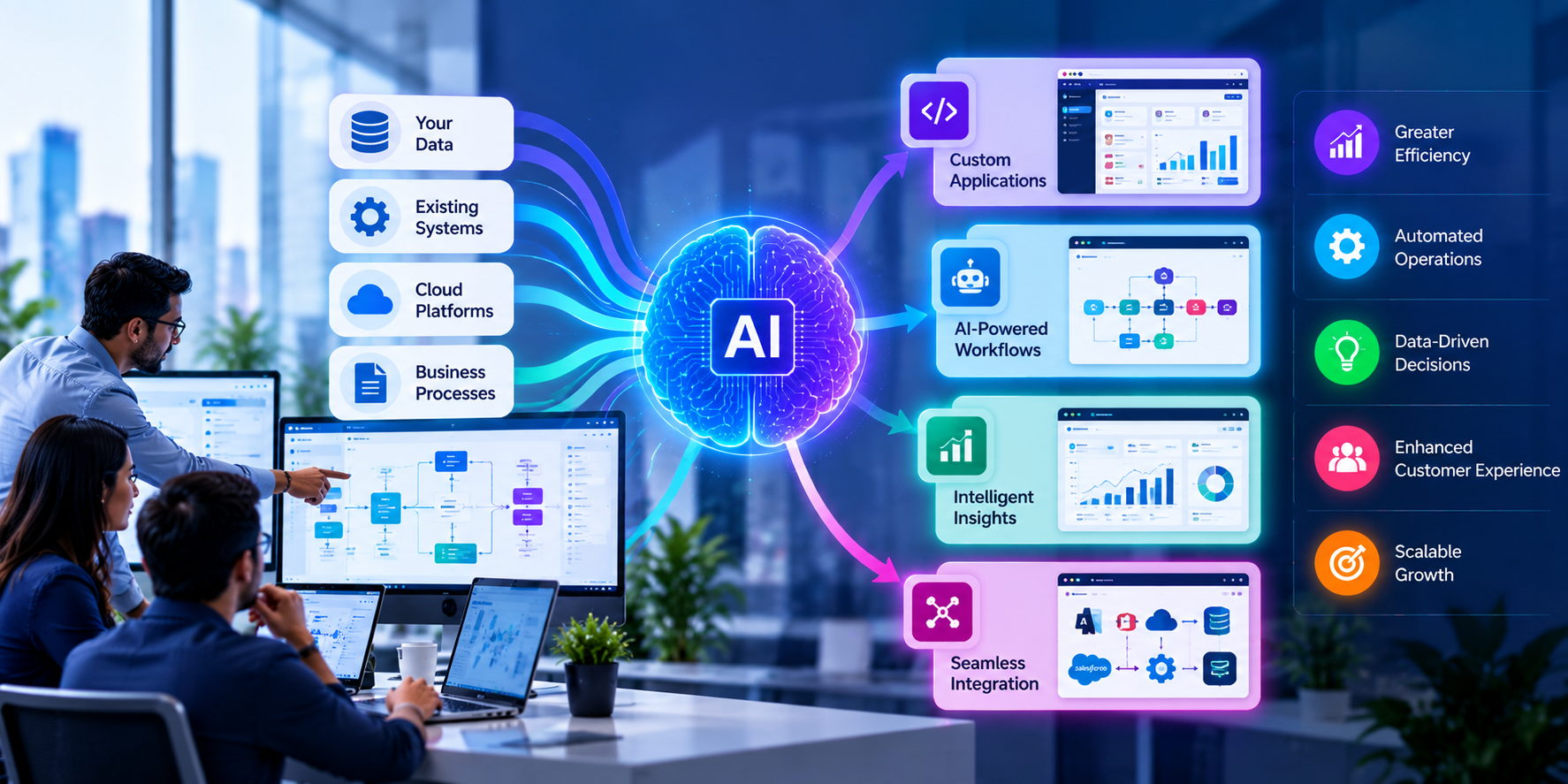
From Manual Decisions to Intelligent Operations
Our Strategy: Build What Your Business Needs. Apply AI Where It Creates Value.

Client Profile

Industry: Specialty Food & Beverage Distribution
Company Size: ~85 employees
Business Model: B2B distributor serving restaurants, retailers, and hospitality customers
Technology Environment: Microsoft 365, ERP, CRM, e-commerce platform, supplier systems, spreadsheets

The company had grown steadily, but many of its operational processes were still dependent on spreadsheets, email, and employee knowledge. Management recognized that simply adding more software would not solve the problem.

They needed a business application designed around the way they actually operated—and AI integrated where it could produce measurable business value.

What the Client Wanted to Achieve

The leadership team wanted to modernize operations while creating a scalable foundation for continued growth.

Key Objectives

  1. Create a single operational workspace
    Bring customer, product, order, inventory, supplier, and operational information together.
  2. Reduce manual decision-making
    Use AI to help employees analyze information and identify issues faster.
  3. Improve demand and inventory visibility
    Identify potential inventory shortages, excess stock, and unusual demand patterns earlier.
  4. Accelerate customer service
    Give employees faster access to customer, order, product, and delivery information.
  5. Reduce spreadsheet dependency
    Replace critical manual processes with structured workflows and purpose-built applications.
  6. Make AI practical—not experimental
    Use AI for specific business problems where it could improve speed, accuracy, or decision-making.
The Challenges

The company already had an ERP, CRM, e-commerce platform, and Microsoft 365.

The problem wasn’t the absence of technology. It was the gap between the technology and the way employees worked.

Operational challenges included:

  • Critical processes managed through spreadsheets
  • Information distributed across multiple applications
  • Employees spending time searching for information
  • Inventory decisions relying heavily on historical experience
  • Customer service representatives manually researching orders
  • Difficulty identifying demand changes early
  • Management reports requiring manual consolidation
  • Valuable operational knowledge residing with individual employees
  • Limited ability to turn existing data into actionable insights

The AI challenge

Leadership was interested in AI but didn’t want a generic chatbot added to the environment simply because AI was popular.

They wanted to know:

Where can AI actually improve the business?

How OJASVI Advised the Client

OJASVI recommended business-first application modernization, rather than beginning with an AI product.

We first mapped the company’s operational processes and identified where employees were spending the most time collecting, interpreting, and acting on information.

We then divided opportunities into three categories:

Automate

Tasks governed by clear business rules.

Assist

Tasks where employees benefit from AI recommendations but should remain in control.

Intelligence

Processes where AI can identify patterns, anomalies, trends, or opportunities that would be difficult to detect manually.

This allowed the client to use AI where it created business value—not where it simply looked impressive.

The Recommended Solution

OJASVI designed a custom Business Operations Application that brought together operational data, workflows, dashboards, and AI capabilities.

Core Application

The application provided employees with a centralized workspace for:

  • Customer information
  • Orders
  • Products
  • Inventory
  • Supplier information
  • Operational tasks
  • Exceptions
  • Approvals
  • Management dashboards

AI Intelligence Layer

AI capabilities were introduced on top of the business data and workflows.

AI-Powered Demand Insights

Analyzed historical sales and order patterns to identify potential changes in demand.

Inventory Risk Detection

Flagged unusual inventory movements and potential shortage or excess-stock situations.

Customer Service Assistant

Allowed representatives to quickly retrieve and summarize relevant customer and order information.

Intelligent Exception Management

Highlighted transactions or situations requiring employee attention instead of forcing staff to manually review everything.

AI-Assisted Summaries

Converted large amounts of operational information into concise summaries for managers and employees.

What OJASVI Solved

The transformation addressed several operational bottlenecks at once.

Before

After

Multiple spreadsheets

Purpose-built business application

Information scattered across systems

Centralized operational workspace

Manual data research

AI-assisted information retrieval

Experience-based inventory decisions

Data + AI-supported insights

Manual exception identification

Intelligent exception detection

Time-consuming reporting

Automated dashboards & summaries

Employees searching for information

Employees receiving relevant information

Reactive decision-making

Earlier visibility into potential issues

The Value Realized With AI

The most important AI benefit was not replacing employees.

It was giving employees the ability to work with significantly more information without spending the same amount of time collecting and interpreting it.

AI helped employees:

See earlier
Potential inventory and demand issues surfaced sooner.

Decide faster
Employees had relevant information and AI-generated insights available in the workflow.

Search less
Customer and operational information could be retrieved conversationally instead of manually searching multiple systems.

Focus better
Employees spent less time reviewing routine information and more time addressing exceptions and customer needs.

Act proactively
The organization could respond to emerging patterns rather than waiting for problems to become obvious.

Business Impact

For a representative SMB environment, the solution could potentially produce measurable operational improvements such as:

Area

Illustrative Impact

Manual reporting & analysis

40–60% reduction

Employee information searches

30–50% reduction

Routine operational research

30–40% reduction

Manual exception review

25–40% reduction

Administrative effort

~70–100 hours/month redirected

These figures are illustrative examples for a representative SMB and are not claimed customer results.

The larger value came from how that recovered capacity was used.

Instead of spending time gathering information, employees could focus on:

  • Customers
  • Supplier relationships
  • Inventory planning
  • Sales opportunities
  • Operational issues
  • Process improvement
  • Business growth

AI With Human Oversight

OJASVI recommended a human-in-the-loop approach.

AI could:

Analyze → Identify → Recommend → Summarize → Prioritize

Employees would:

Review → Decide → Approve → Act

This gave the client the benefits of AI while maintaining appropriate human judgment over important business decisions.

How This Adds Long-Term Value

The solution was designed as a platform for continuous improvement, rather than a one-time application project.

As the company accumulates more operational data, the organization can progressively introduce additional capabilities:

Phase 1 — Digitize

Replace spreadsheets and manual processes.

Phase 2 — Connect

Bring business information together.

Phase 3 — Automate

Remove repetitive workflow activities.

Phase 4 — Intelligence

Use AI to identify patterns, exceptions, and opportunities.

Phase 5 — Predict

Move toward forecasting demand, inventory requirements, customer behavior, and operational needs.

Phase 6 — Optimize

Continuously improve processes based on real operational data.

This creates a path from digitization → automation → intelligence → optimization.

The Long-Term Business Value

The client didn’t just receive a custom application.

They established a digital operating foundation that can evolve with the business.

As the company grows, the platform can support:

  • More customers
  • More products
  • More transactions
  • Additional locations
  • New suppliers
  • New sales channels
  • Additional AI capabilities
  • Advanced analytics
  • Predictive decision support

Most importantly, AI becomes part of the business workflow rather than a separate technology experiment.

The OJASVI Difference

OJASVI approached AI transformation from the business process backward.

We didn’t ask:

“Where can we put AI?”

We asked:

“Where is the business losing time, insight, or opportunity—and where can intelligent technology change the outcome?”

Our approach:

Discover → Design → Build → Integrate → Apply AI → Measure → Continuously Improve

The Result

The company moved from fragmented information and manual decision-making toward a connected, intelligent operating environment.

Employees spent less time searching, compiling, and reviewing information—and more time acting on it.

Management gained greater visibility.

Operations became more scalable.

And AI moved from an experimental concept to a practical business capability embedded directly into everyday work.

Scroll to Top

"*" indicates required fields

"*" indicates required fields

Step 1 of 19

Analytics Journey Assessment Questionnaire
Digital transformation often requires skills across multiple roles and departments. This Analytics assessment questionnaire will walk you through a series of questions to evaluate your company’s readiness for implementing analytics in the departments that matter most in the company.
Please take a moment to complete the questionnaire

"*" indicates required fields

Step 1 of 22

Cloud Adoption Assessment Questionnaire
Digital transformation often requires skills across multiple roles and departments. This Cloud adoption assessment questionnaire will walk you through a series of questions to evaluate your company’s readiness for cloud adoption in various areas.
Please take a moment to complete the questionnaire

"*" indicates required fields

Step 1 of 7

Cloud Governance Assessment Questionnaire
Digital transformation often requires skills across multiple roles and departments. This Migration assessment questionnaire will walk you through a series of questions to evaluate your company’s readiness for cloud migration in various areas.
Please take a moment to complete the questionnaire

"*" indicates required fields

Step 1 of 52

Devops Capability Assessment
Digital transformation often requires skills across multiple roles and departments. This DevOps assessment questionnaire will walk you through a series of questions to evaluate your company’s readiness to adopt continuous processes throughout.
Please take a moment to complete the questionnaire

"*" indicates required fields

Step 1 of 40

Planning Cloud Journey Assessment Questionnaire
Digital transformation often requires skills across multiple roles and departments. This Cloud planning assessment questionnaire will walk you through a series of questions to evaluate your company’s readiness for moving to cloud & strategy.
Please take a moment to complete the questionnaire

"*" indicates required fields

Step 1 of 12

Power Platform Adoption Assessment Questionnaire
This assessment questionnaire will walk you through a series of questions to evaluate your company’s readiness for Power Platform suite of tools to automate and enhance your company’s productivity. Please take a moment to complete this questionnaire.
Please take a moment to complete the questionnaire

"*" indicates required fields

Step 1 of 17

Cloud Migration Assessment Questionnaire
This Migration assessment questionnaire will walk you through a series of questions to evaluate your company’s readiness for cloud migration in various areas.
Please take a moment to complete the questionnaire